
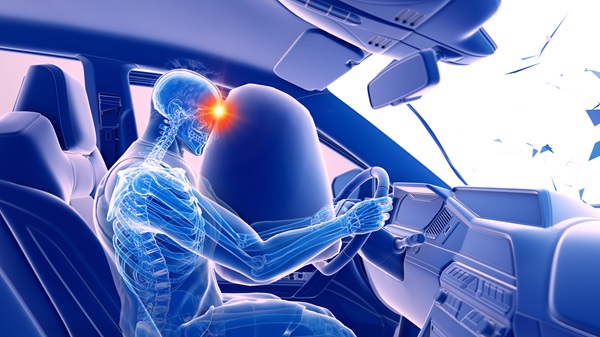
The car accident happens. Your heart is pounding, your hands are shaking, and somewhere in the back of your mind, you register that your head made contact with something hard. But you’re standing, you’re talking, and you feel okay. So you exchange insurance information, maybe take a few photos, and start thinking about your afternoon. The problem is that "feeling okay" after hitting your head in a crash is one of the least reliable indicators of whether you actually are. Since March is Brain Injury Awareness Month, this is something every driver should be aware of.
In the minutes after a collision, your body’s stress response suppresses pain signals and creates a temporary sense of clarity that has very little to do with the condition of your brain. Head injuries, including serious ones, can take hours or even days to announce themselves. By then, important windows for both medical treatment and legal documentation may already be closing. Here’s what you actually need to know if you hit your head in a car accident, from what’s happening inside your skull to what steps protect both your health and your claim.
What’s actually happening inside your skull after a car accident impact?
Most people picture a head injury as a straightforward collision between skull and surface. The reality is more complicated. Your brain floats inside the skull, cushioned by cerebrospinal fluid. In a crash, the sudden, violent change in direction sends the brain shifting inside the cranial cavity. It can strike one side of the skull on impact, then rebound and strike the opposite side, causing damage in two separate locations from a single event. This is called a coup-contrecoup injury, and it helps explain why someone can hit their head on the driver’s side window and end up with injury on both sides of the brain.
Also, when a crash involves any twisting or lateral motion, the brain’s layers rotate at slightly different speeds, stretching and tearing the microscopic nerve fibers connecting them. This is diffuse axonal injury, and it can occur even without direct head contact. It rarely shows up on standard imaging, which is part of why so many head injuries are underdiagnosed or dismissed entirely.
Low-speed crashes are not automatically low-risk crashes. Significant head injuries have occurred in collisions that left vehicles with barely a scratch. Crash appearance is not a reliable guide to injury severity, and neither is how you feel at the scene.
What symptoms should tell you something is wrong?
Some symptoms demand immediate emergency attention. If you or anyone at the scene experiences any of the following, call 911 without hesitation:
- Loss of consciousness, even briefly, even for a few seconds
- Seizures at the scene or in the hours following the crash
- Repeated vomiting, which can signal elevated pressure inside the skull
- Unequal pupil size, slurred speech, or inability to recognize people or places
- Clear fluid from the nose or ears, which can indicate a skull fracture
Other symptoms develop more gradually and are easier to overlook or rationalize. Headaches that worsen over time, persistent dizziness, trouble concentrating, short-term memory gaps, sensitivity to light or noise, visual disturbances, mood changes, and disrupted sleep are all potential signs of a brain injury that emerged after the initial shock wore off. These delayed symptoms are especially dangerous because they’re easy to attribute to stress, soreness, or the general chaos of dealing with an accident. Meanwhile, the underlying injury continues without treatment or documentation.
There’s also a risk worth knowing about called second impact syndrome. If you sustain a second concussion before the first has fully healed, the consequences can be severe and life-threatening. Returning to normal activity too quickly, especially strenuous work or anything physically demanding, before being cleared by a physician, carries real risk.
What kind of medical evaluation do I actually need after a crash?
An emergency room visit is a starting point, not a finishing line. ER evaluations are built to catch life-threatening emergencies, not the subtler neurological changes that characterize mild TBI. If symptoms persist or develop after your initial visit, push for more. Here's what a thorough evaluation can include:
- Standard CT and MRI: Effective at ruling out bleeds, fractures, and structural damage, but largely miss diffuse axonal injury and the metabolic disruption that follows a concussion.
- Diffusion tensor imaging (DTI) and functional MRI: Advanced imaging options that can identify damage standard scans won't show, and are worth requesting if symptoms persist after initial evaluation.
- Neuropsychological evaluation: Standardized testing of memory, attention, processing speed, and executive function that produces objective, documented results, which are significantly harder for an insurance company to dismiss than self-reported symptoms alone.
- Vestibular and oculomotor testing: Assesses balance and eye movement, both of which are frequently disrupted after head trauma and routinely overlooked in standard evaluations.
- Specialist referrals: If your primary care doctor isn't connecting the dots, ask for a referral to a neurologist or a dedicated concussion clinic.
How does a head injury change your car accident claim?
Head injuries are among the most routinely undervalued injuries in early settlement offers. Insurance adjusters know that TBI symptoms are subjective, that standard imaging often shows nothing abnormal, and that many victims don’t fully understand what they’ve experienced. That combination makes head injuries a prime target for low offers and outright disputes.
Gaps in treatment are one of the most powerful tools an insurance company has. If you stop seeking care before your symptoms resolve, or if weeks pass between appointments, adjusters will argue that your injuries were minor and have since healed. The symptoms you report to your doctor, the symptoms you describe in your journal, and the symptoms you discuss with your attorney should all align. Insurance companies use even small inconsistencies to undermine your credibility.
Settling too quickly is a particular risk with head injuries. The full scope of a traumatic brain injury may not be clinically clear for weeks or months after the crash. Early settlement offers rarely account for future medical care, cognitive rehabilitation, reduced earning capacity, or the long-term impact on daily life and relationships. Once you accept a settlement, that door closes permanently.
Hurt in a San Antonio car accident? The Herrera Law Firm is ready to fight for you.
After a car accident in San Antonio, the insurance company isn't on your side. They have adjusters, attorneys, and years of experience finding reasons to pay you less. The Herrera Law Firm levels that playing field. From investigating the crash scene and gathering evidence to negotiating with insurance companies and taking cases to court when necessary, our San Antonio car accident lawyers handle every detail so you can focus on recovering. We serve clients throughout San Antonio, Bexar County, and communities across South Texas, and we know exactly how local insurance companies operate and what it takes to beat them.
The best part is that it costs you nothing to find out where you stand. We offer free consultations and work exclusively on a contingency-fee basis, meaning you pay nothing unless we win. There are no upfront costs, no hourly billing, and no financial risk. If you or someone you love was hurt in a crash, contact us today for your free case review and let us start fighting for you.
